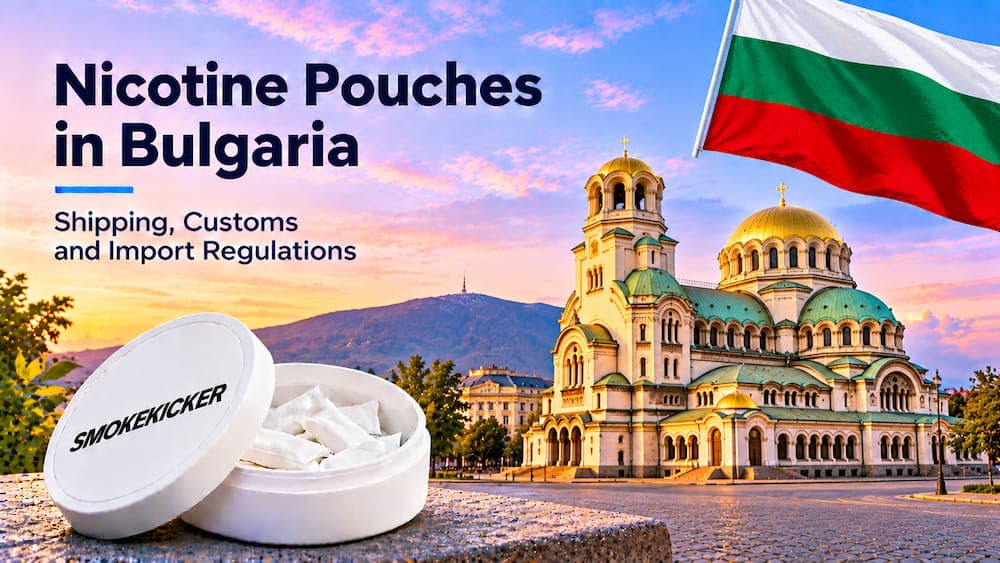
Buying Nicotine Pouches in Bulgaria: Shipping, Customs and Import Regulations
Explore Bulgaria's nicotine pouch market and learn about shipping from Sweden, customs duties, VAT, and import regulations. This guide covers Bulgaria's 20 mg nicotine limit, restrictions on online sales, the 20% VAT rate, nicotine pouch excise taxes, and important regulatory developments in 2026.
The international nicotine pouch market has expanded considerably in recent years, with Sweden playing an important role in the development and distribution of tobacco-free nicotine products.
Bulgaria, meanwhile, has an established market for conventional tobacco products, electronic cigarettes, heated tobacco products, and other nicotine-containing products.
As nicotine pouches become increasingly familiar throughout Europe, Bulgarian consumers may encounter Swedish products through local retailers, international websites, and specialized nicotine pouch stores.
However, purchasing nicotine pouches from overseas involves several important considerations. Bulgaria has introduced restrictions on nicotine strength, packaging, product safety, and distribution, while its excise tax system has also undergone substantial changes.
International purchases may involve Value Added Tax (VAT), nicotine-specific excise duties, shipping restrictions, and requirements applying to businesses distributing nicotine products within Bulgaria.
For consumers researching international nicotine pouch retailers such as Smokekicker, understanding these requirements is particularly important.
This guide explores the legal status of nicotine pouches in Bulgaria, shipping from Sweden, customs regulations, taxation, and what consumers should know about international purchases in 2026.
The Nicotine Pouch Market in Bulgaria
Nicotine pouches, commonly referred to as никотинови паучове or никотинови торбички in Bulgarian, are small oral products containing nicotine, plant-based fibers, flavorings, and other ingredients.
Unlike traditional Swedish snus, tobacco-free nicotine pouches do not contain tobacco leaf. They are placed between the upper lip and gum, where nicotine is absorbed through the oral lining without combustion or vapor.
Nicotine pouches have developed into an established product category in Sweden and several other European markets.
In Bulgaria, the category has received increasing attention from regulators and customs authorities.
The government has introduced specific requirements concerning nicotine content, packaging information, and the taxation of tobacco substitutes containing nicotine.
These developments are particularly relevant to consumers researching Swedish products, which may have different nicotine strengths, packaging formats, and formulations from those permitted in Bulgaria.
Are Nicotine Pouches Legal in Bulgaria?
Yes. Tobacco-free nicotine pouches are generally legal in Bulgaria when they meet the applicable national requirements.
However, Bulgaria distinguishes between tobacco-containing oral products and tobacco-free nicotine pouches.
This distinction is important because the two categories are subject to different legal restrictions.
Tobacco-Free Nicotine Pouches vs. Traditional Snus
Traditional Swedish snus contains tobacco leaf and is subject to the European Union's prohibition on the commercial sale of tobacco for oral use outside Sweden.
Modern nicotine pouches, by contrast, contain nicotine without tobacco leaf.
Bulgaria's tobacco legislation specifically recognizes nicotine-containing products without tobacco, including products supplied in small pouches.
These products are subject to national controls concerning nicotine concentration and consumer information.
Consequently, a product legally marketed as snus in Sweden does not automatically qualify for lawful distribution in Bulgaria.
Consumers should verify whether the product contains tobacco and whether it satisfies Bulgarian product requirements.
Nicotine Pouch Regulations in Bulgaria in 2026
Bulgaria introduced important changes through amendments to its Law on Tobacco, Tobacco and Related Products, commonly referred to as the Tobacco Act.
Amendments published in State Gazette No. 54 of 2025 established a prohibition on selling nicotine-containing products exceeding 20 mg of nicotine per individual unit.
The restriction entered into force on July 4, 2025.
Further provisions address health warnings, packaging, and enforcement against non-compliant products.
Key Nicotine Pouch Requirements
|
Requirement |
Bulgaria's 2026 framework |
|---|---|
|
Product legality |
Permitted if compliant |
|
Maximum nicotine content |
20 mg per individual pouch |
|
Minimum purchasing age |
18 years |
|
Traditional tobacco snus |
Commercial sale prohibited |
|
Packaging and health warnings |
Bulgarian-language requirements |
|
Cross-border distance sales |
Restricted; product-specific applicability requires verification |
|
Excise duty up to 20 mg per unit |
€20 per kilogram |
|
Standard VAT |
20% |
|
National currency |
Euro |
These requirements must be considered together.
A nicotine pouch that meets the nicotine strength restriction may still fail to satisfy other relevant legal or tax requirements.
Bulgaria's 20 mg Nicotine Limit
One of Bulgaria's most important product restrictions concerns nicotine strength.
Under Article 30(2)(21) of the Tobacco Act, the offer and sale of nicotine-containing products exceeding 20 mg of nicotine per individual unit are prohibited.
For ordinary nicotine pouches, this means the actual nicotine amount in each pouch is particularly important.
Milligrams per Pouch vs. Milligrams per Gram
Manufacturers use different measurements to describe nicotine content.
Some products display the total nicotine content in milligrams per pouch.
Others express the nicotine concentration in milligrams per gram.
These measurements are not interchangeable.
For example, consider a pouch weighing 0.7 grams with a nicotine concentration of 20 mg/g.
The actual nicotine content would be:
20 mg/g × 0.7 g = 14 mg per pouch
This product would fall below Bulgaria's 20 mg maximum based on nicotine content alone.
By contrast, a pouch containing 25 mg of nicotine would exceed the permitted maximum, regardless of its weight.
Does Every Product Below 20 mg Qualify?
Not automatically. Nicotine concentration is only one consideration.
Products must also satisfy applicable requirements concerning composition, labeling, taxation, and lawful distribution.
Packaging and Health Warning Requirements
Bulgaria's tobacco legislation contains specific requirements addressing nicotine-containing products.
These include prescribed health warnings designed to communicate the addictive nature of nicotine.
Mandatory Health Warning
The Bulgarian legislation specifies the following warning:
"Това изделие съдържа никотин, който води до силно пристрастяване. Не се препоръчва за употреба от непушачи."
In English, this means:
"This product contains nicotine, which is highly addictive. It is not recommended for use by non-smokers."
The legislation establishes presentation requirements, including a warning covering 30% of the largest surface of the relevant packaging.
The applicability and commencement of particular packaging provisions should be confirmed against the relevant implementing rules and transitional deadlines.
Why Packaging Matters for International Products
A nicotine pouch packaged for sale in Sweden may contain Swedish-language consumer information.
However, products placed on the Bulgarian market may require Bulgarian-language information and compliance with the relevant national packaging standards. Retailers should therefore verify packaging requirements before introducing international products to the market.
Can You Buy Nicotine Pouches Online in Bulgaria?
Online sales are one of the most important legal considerations for international nicotine pouch purchases.
Bulgaria's Tobacco Act contains restrictions on cross-border distance selling and online sales of tobacco and related products.
Article 31a prohibits cross-border distance sales and the offering or sale of covered products through information society services.
What About Tobacco-Free Nicotine Pouches?
Bulgaria separately defines nicotine-containing products without tobacco.
However, the precise application of Article 31a to every tobacco-free nicotine pouch transaction requires careful interpretation of the country's legislation.
The existence of domestic websites offering nicotine pouches should not be treated as definitive evidence that every sale is legally authorized.
Similarly, an overseas retailer accepting Bulgarian customers does not automatically establish that cross-border transactions are permitted.
What About International Online Retailers?
Consumers may encounter nicotine pouches through Swedish and other European websites.
However, international retailers operate under different regulatory systems.
For example, nicotine pouches legally sold online in Sweden may have different nicotine strengths, packaging, and tax arrangements.
Retailers intending to supply Bulgarian consumers must consider the national rules governing distance sales, product compliance, and excise taxation.
For consumers researching international retailers such as Smokekicker, the distinction between product availability and legal delivery eligibility remains important.
Where Can Nicotine Pouches Be Purchased in Bulgaria?
Compliant tobacco-free nicotine pouches may be available through domestic retail outlets operating under Bulgaria's applicable laws.
Retailers must observe age restrictions, product safety requirements, and applicable tax obligations.
Minimum Purchasing Age
Bulgaria prohibits sales of covered tobacco and nicotine products to individuals under 18.
Retailers must ensure that nicotine products are not supplied to minors.
Product Compliance
Consumers should check that products satisfy the country's nicotine strength requirements. Packaging, product information, and other regulatory conditions may also affect eligibility.
The availability of nicotine pouches through a physical retail outlet does not automatically establish that every product meets the required standards.
Shipping Nicotine Pouches from Sweden to Bulgaria
Sweden is one of the world's leading markets for tobacco-free nicotine pouches.
Swedish manufacturers produce products with different nicotine strengths, pouch formats, moisture levels, and formulations.
International shipping services connect Sweden with Bulgaria, including destinations such as Sofia, Plovdiv, Varna, Burgas, Ruse, and Stara Zagora.
However, nicotine pouch shipments can involve additional requirements compared with ordinary consumer goods.
Shipping Restrictions and Product Eligibility
Sweden and Bulgaria are both members of the European Union.
For ordinary goods already in free circulation within the EU, transportation between the countries generally does not involve customs duties.
However, nicotine pouches are subject to Bulgaria's national product and excise legislation.
Shipping providers may also maintain restrictions on transporting nicotine-containing products.
The fact that a carrier delivers ordinary parcels to Bulgaria does not establish that every nicotine pouch product can legally be shipped to a consumer.
Does EU Free Movement Allow Nicotine Pouch Sales in Bulgaria?
The European Union generally protects the free movement of goods between member states.
However, member states may establish national product restrictions for public health and consumer protection, subject to EU law.
Tobacco-free nicotine pouches are not currently regulated under a fully harmonized EU product framework. As a result, different European countries apply different requirements.
For example, some countries permit regulated online sales, while others prohibit cross-border nicotine pouch transactions.
What Does This Mean for Consumers?
A nicotine pouch legally sold in Sweden does not automatically qualify for every sales or distribution arrangement in Bulgaria. Even when ordinary customs duties do not apply, retailers must still consider the country's product, taxation, and distance-selling requirements.
Consumers should therefore distinguish between the physical ability to ship a parcel and the legal requirements governing the underlying transaction.
Bulgaria's Adoption of the Euro in 2026
An important development affecting the Bulgarian consumer market occurred on January 1, 2026, when Bulgaria adopted the euro.
The euro replaced the Bulgarian lev at the fixed conversion rate:
€1 = BGN 1.95583
This change made Bulgaria the 21st member of the euro area.
What Does This Mean for Swedish Retailers?
For international retailers, Bulgaria's adoption of the euro simplifies some aspects of pricing and currency comparisons.
Retailers using euros can display prices in the same currency now used domestically in Bulgaria.
However, this does not eliminate applicable VAT or nicotine excise requirements.
For consumers, final prices should still be evaluated in terms of product cost, taxes, delivery charges, and any applicable regulatory fees.
Bulgarian Customs Duties and VAT
International purchases entering Bulgaria may be subject to customs duties, VAT, excise duties, and other charges depending on their origin and product classification.
However, goods transported from Sweden receive different treatment from products imported from outside the European Union.
Bulgaria applies a standard VAT rate of 20%.
Understanding Import Charges
|
Charge |
General treatment |
|---|---|
|
Customs duty from Sweden |
Generally 0% for goods in EU free circulation |
|
Bulgarian VAT |
Standard rate of 20% |
|
Excise duty up to 20 mg per unit |
€20 per kilogram |
|
Imports from outside the EU |
May involve customs duties and import VAT |
|
Excise compliance |
Applicable to regulated nicotine products |
|
International shipping |
Depends on the retailer and carrier |
These charges must be considered separately from product and sales restrictions.
Buying from Another EU Country
For ordinary goods transported from Sweden to Bulgaria, customs duties generally do not apply.
VAT is handled under the applicable EU cross-border transaction rules. However, Bulgaria maintains its own excise duties on nicotine-containing tobacco substitutes.
The absence of customs duties does not automatically eliminate those tax obligations.
Bulgaria's Nicotine Pouch Excise Duty in 2026
Bulgaria taxes nicotine-containing tobacco substitutes under its Excise Duties and Tax Warehouses Act.
The legislation distinguishes products according to their nicotine content per individual unit.
From August 1, 2026, the excise rates are:
|
Product category |
Excise duty |
|---|---|
|
Up to and including 20 mg nicotine per unit |
€20 per kilogram |
|
Above 20 mg nicotine per unit |
€64 per kilogram |
The higher tax category should not be interpreted as permission to sell nicotine pouches exceeding the separate 20 mg legal maximum.
Future Excise Duty Changes
Bulgaria has also established scheduled increases.
|
Effective date |
Up to 20 mg per unit |
Above 20 mg per unit |
|---|---|---|
|
August 1, 2026 |
€20/kg |
€64/kg |
|
March 1, 2027 |
€23/kg |
€69/kg |
|
January 1, 2028 |
€28/kg |
€73/kg |
These are statutory rates and may change through future legislation.
For compliant nicotine pouches, the lower-rate category is particularly relevant.
How Is Bulgarian Nicotine Excise Duty Calculated?
Bulgaria's nicotine pouch excise duty is calculated according to the relevant taxable product weight.
Consider a hypothetical nicotine pouch can containing 20 pouches. Assume each pouch has a taxable weight of 0.7 grams and contains no more than 20 mg of nicotine. The total taxable weight would be:
20 × 0.7 g = 14 g
Expressed in kilograms:
14 g = 0.014 kg
At €20 per kilogram:
0.014 kg × €20 = €0.28
The illustrative excise duty would therefore be €0.28 per can.
Example of Bulgarian Nicotine Excise Duty
|
Taxable weight per can |
Excise duty at €20/kg |
|---|---|
|
10 g |
€0.20 |
|
12 g |
€0.24 |
|
14 g |
€0.28 |
|
16 g |
€0.32 |
|
20 g |
€0.40 |
These examples are hypothetical and illustrate the statutory rate.
Actual calculations depend on the applicable legal definition of taxable weight and relevant reporting requirements.
The amounts do not represent retail prices.
The final price may also include VAT, product costs, distribution expenses, and retailer margins.
Does Buying from Sweden Avoid Bulgarian Nicotine Taxes?
No. Although Sweden and Bulgaria belong to the European Union, Bulgaria maintains its own excise tax system for nicotine-containing tobacco substitutes.
A product being sold or taxed in Sweden does not automatically establish that all applicable Bulgarian tax requirements have been satisfied.
Businesses involved in lawful distribution must consider the relevant excise registration, declaration, and payment requirements. Similarly, paying the applicable tax does not override restrictions on sales channels or non-compliant products.
How Is VAT Calculated in Bulgaria?
Bulgaria applies a standard VAT rate of 20%.
For ordinary taxable transactions, VAT is generally calculated on the applicable taxable selling price.
Consider a hypothetical product with a taxable net value of €10.
|
Charge |
Illustrative amount |
|---|---|
|
Net taxable price |
€10.00 |
|
VAT at 20% |
€2.00 |
|
Total including VAT |
€12.00 |
This is a simplified VAT illustration.
It does not establish the actual retail price or complete tax treatment of nicotine pouches.
Where excise duties apply, the relevant excise amount can also affect the VAT taxable base.
The final price therefore depends on the product's tax treatment and commercial arrangements.
Bulgarian Customs Enforcement and Nicotine Pouches
Bulgaria's customs authorities have increased scrutiny of nicotine-containing products, particularly products transported through postal and courier networks. In 2026, Bulgarian authorities reported enforcement activity involving nicotine pouches and other products distributed through shipping companies.
An October 2026 case involved hundreds of containers marketed as nicotine pouches that were found to contain tobacco.
Because the products contained tobacco, they were classified as oral tobacco products rather than tobacco-free nicotine pouches. Authorities prohibited their placement on the market.
Why Is Product Composition Important?
A product being marketed as a nicotine pouch does not necessarily establish that it is tobacco-free.
The actual ingredients determine its legal classification. For example, products containing tobacco material may fall within the European Union's prohibition on oral tobacco sales.
Consumers and retailers should therefore verify the composition of products rather than relying solely on their commercial descriptions.
Can You Import Nicotine Pouches for Personal Use?
Personal importation is an important consideration for consumers researching nicotine pouches from overseas. However, Bulgaria's rules concerning tobacco and nicotine product distribution must be considered separately from ordinary personal-use customs arrangements.
What About Small International Orders?
Consumers may assume that ordering only a few nicotine pouch cans from Sweden qualifies as personal importation. However, the size of an order does not automatically determine whether the transaction is legally permissible.
A small international order remains a commercial transaction when purchased from an overseas retailer. The applicable distance-selling, excise, and product requirements must therefore be considered.
There is no general nicotine-pouch-specific exemption establishing that every small international online order can be lawfully fulfilled.
What About Travelers Bringing Nicotine Pouches into Bulgaria?
Travelers may encounter nicotine pouches while visiting Sweden and other countries where they are legally available.
However, physically transporting products for personal use differs from arranging a commercial shipment. Conventional tobacco allowances should not automatically be applied to tobacco-free nicotine pouches.
Travelers should verify the relevant rules concerning quantities, product classification, and any applicable excise requirements.
Swedish Nicotine Pouches and International Retailers
Sweden has developed one of the world's most established nicotine pouch industries. The European market includes products with different nicotine strengths, pouch formats, moisture levels, and formulations.
Some manufacturers express nicotine content in milligrams per pouch, while others use milligrams per gram. These measurements are not interchangeable.
For example, a pouch weighing 0.7 grams with a nicotine concentration of 12 mg/g contains approximately 8.4 mg of nicotine.
For Bulgarian consumers, the actual nicotine content is particularly important because products exceeding 20 mg per unit cannot legally be offered for sale.
International nicotine pouch retailers such as Smokekicker provide information about the wider European nicotine pouch market.
For consumers in Bulgaria researching the category, Swedish retailers can offer insight into product characteristics and differences between national regulations.
However, products legally available in Sweden are not automatically eligible for every form of online sale or international delivery to Bulgaria.
The Future of Nicotine Pouches in Bulgaria
Bulgaria's nicotine pouch regulatory framework has developed considerably during 2025 and 2026.
The introduction of a maximum nicotine content of 20 mg per unit established an important national product restriction.
Additional packaging requirements and enforcement measures have strengthened oversight of nicotine-containing products. Meanwhile, the country's excise tax system distinguishes between products according to nicotine strength and includes scheduled increases through 2028.
Bulgaria's adoption of the euro in January 2026 also changed the currency used for domestic taxation and consumer prices. At the European level, broader discussions concerning the regulation and taxation of emerging nicotine products could introduce further changes.
For consumers and international retailers, Bulgaria demonstrates how tobacco-free nicotine pouches can remain legally available while product, tax, and distribution requirements continue to evolve.
Consumers and businesses should monitor official announcements from the Bulgarian Customs Agency, Ministry of Finance, Consumer Protection Commission, and relevant European institutions.
Final Thoughts
Bulgaria represents a regulated market for tobacco-free nicotine pouches.
Unlike Germany, where ordinary commercial nicotine pouch distribution is generally restricted, Bulgaria permits compliant tobacco-free nicotine products under its national legislation.
However, the country's regulations impose important restrictions on nicotine strength, packaging, taxation, and certain sales arrangements. For consumers researching Swedish online retailers such as Smokekicker, understanding these requirements is essential.
International shipping from Sweden generally does not involve ordinary customs duties because both countries belong to the European Union. Nevertheless, Bulgaria's 20% VAT, nicotine pouch excise duty, product restrictions, and distance-selling provisions remain relevant.
The most important developments include the 20 mg nicotine limit per unit, the €20-per-kilogram excise duty effective August 2026, and Bulgaria's adoption of the euro.
Consumers should verify that products and purchasing arrangements comply with Bulgarian requirements before considering international orders.
Important information: Nicotine is addictive, and nicotine pouches are not risk-free. Nicotine products should not be used by minors or people who do not already consume nicotine. This article is intended for general informational purposes only and does not constitute legal or tax advice. Product regulations, taxation, and shipping restrictions may change.
Last updated: November 2026.