
Buying Nicotine Pouches in Japan: Customs and Import Regulations
Explore Japan's nicotine pouch market and learn about shipping from Sweden, customs duties, and import regulations. This guide explains the difference between tobacco-containing and tobacco-free nicotine pouches, Japan's 10% consumption tax, the ¥10,000 customs exemption, and important personal import requirements.
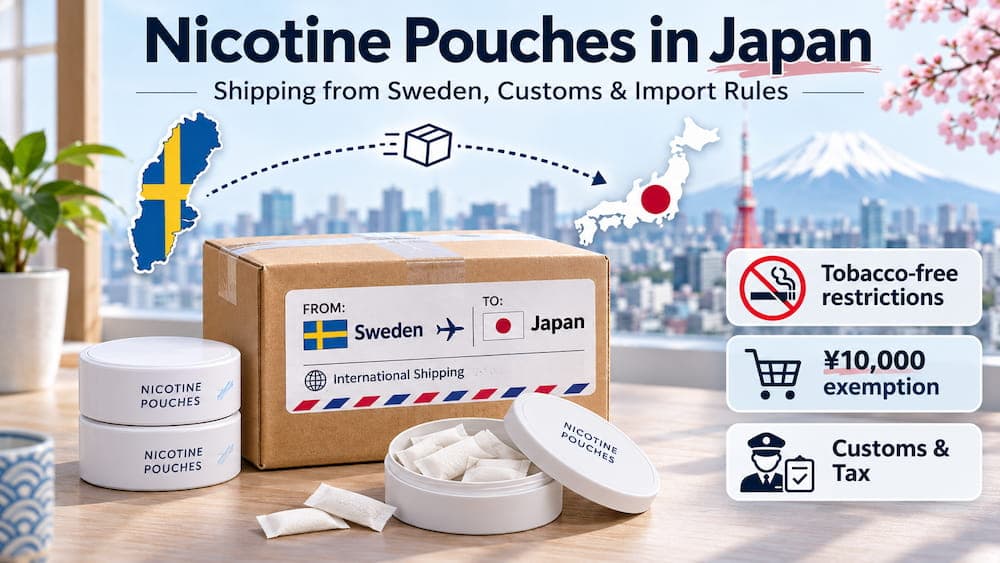
The international nicotine pouch market has expanded considerably in recent years, with Sweden playing an important role in the development and distribution of modern oral nicotine products.
Japan, meanwhile, has developed a distinctive nicotine market, particularly through its widespread adoption of heated tobacco products and established tobacco retail industry.
As nicotine pouches become increasingly familiar internationally, consumers in Japan may encounter Swedish products through overseas websites and specialist retailers.
However, buying nicotine pouches from overseas involves several important considerations. Japanese regulations distinguish between tobacco-containing products, tobacco-free nicotine products, and pharmaceutical products containing nicotine.
International shipments may also be subject to customs duties, consumption tax, product restrictions, and import documentation requirements.
For consumers researching Swedish nicotine pouch online retailers such as Smokekicker, understanding these differences is particularly important.
This guide explains the legal status of nicotine pouches in Japan, shipping from Sweden, customs regulations, import taxes, and what consumers should know before considering international purchases in 2026.
The Nicotine Pouch Market in Japan
Nicotine pouches are small oral products containing nicotine, fibers, and other ingredients.
They are generally placed between the upper lip and gum, allowing nicotine to be absorbed through the oral lining without combustion or vapor. Modern Swedish nicotine pouches are usually tobacco-free, meaning they contain nicotine but no tobacco leaf. However, not all oral nicotine pouches are tobacco-free.
Some products contain processed tobacco material and are regulated differently.
This distinction is particularly relevant in Japan, where tobacco-containing oral products can fall under the country's established tobacco legislation.
Japan's Growing Interest in Oral Nicotine Products
Japan has an established market for cigarettes and heated tobacco products.
In recent years, manufacturers have also introduced oral tobacco products designed for use without smoking or heating.
One notable development occurred in 2026 when Philip Morris Japan expanded sales of ZYN by IQOS in Tokyo.
The expansion began on May 11, 2026, following an earlier limited launch in July 2025.
Unlike conventional tobacco-free nicotine pouches, the Japanese ZYN product contains processed tobacco leaf and tobacco-derived ingredients.
This allows it to be positioned within Japan's existing tobacco product framework.
For consumers, the distinction highlights why a product's ingredients and legal classification matter more than its brand name or physical appearance.
Are Nicotine Pouches Legal in Japan?
The legal status of nicotine pouches in Japan depends on the product's composition.
Tobacco-containing oral products are generally regulated under Japan's Tobacco Business Act.
However, tobacco-free nicotine pouches are subject to a different and more restrictive regulatory environment.
Tobacco-Containing Oral Pouches
Products containing tobacco leaf can fall within Japan's established tobacco legislation.
The Tobacco Business Act regulates the manufacturing, importation, distribution, and sale of tobacco products.
Commercial tobacco importers and distributors must comply with applicable registration and licensing requirements.
The minimum legal age for purchasing and consuming tobacco products in Japan is 20 years.
Tobacco-Free Nicotine Pouches
Tobacco-free nicotine pouches do not contain tobacco leaf, even when their nicotine originates from tobacco plants. As a result, they are not automatically covered by the same rules as conventional tobacco products.
Nicotine-containing products without tobacco can instead fall within Japan's pharmaceutical regulatory framework.
Commercial distribution may require authorization under the Pharmaceuticals and Medical Devices Act.
As of November 2026, tobacco-free nicotine pouches have not established a generally authorized retail market in Japan. Consumers should therefore not assume that products legally sold in Sweden can also be legally marketed or imported into Japan.
Can You Buy Nicotine Pouches Online in Japan?
The answer depends on the product and the applicable regulatory classification.
Tobacco-containing oral products may be sold through authorized channels, subject to Japan's tobacco legislation and retailer requirements.
Tobacco-free nicotine pouches, however, present additional regulatory challenges.
International retailers offering Swedish nicotine pouches must consider whether the products can legally be supplied to Japanese consumers.
The availability of an international online store does not establish that every product can legally enter Japan.
Are Personal Online Imports Allowed?
Japan permits individuals to import certain pharmaceutical products for personal use under specified conditions.
However, these arrangements should not be interpreted as blanket permission to import tobacco-free nicotine pouches.
The Ministry of Health, Labour and Welfare (MHLW) establishes import procedures for pharmaceutical products, including quantity restrictions and requirements for import confirmation certificates.
Whether a particular nicotine pouch qualifies for personal importation depends on its ingredients, classification, quantity, and other applicable requirements.
Consumers should obtain confirmation from Japanese customs and health authorities before arranging an international order.
Shipping Nicotine Pouches from Sweden to Japan
Sweden has one of the world's most established nicotine pouch industries, with manufacturers producing different formulations, pouch formats, and nicotine strengths.
International shipping services connect Sweden with Japan, including destinations such as Tokyo, Osaka, Kyoto, Yokohama, Nagoya, and Fukuoka.
However, the availability of international parcel services does not automatically establish that nicotine pouches can legally be transported or imported.
Shipping Restrictions and Product Eligibility
Shipping providers may maintain restrictions on tobacco, nicotine, and pharmaceutical products.
These restrictions can differ between carriers and destination countries.
For shipments entering Japan, customs declarations typically require information about the goods, including their description, declared value, quantity, and country of origin.
Regulated products may also require additional documentation.
For tobacco-free nicotine pouches, the most important consideration is whether the product can legally be imported under Japan's applicable pharmaceutical or other product regulations.
Consumers should verify product eligibility before arranging shipment.
Japanese Customs Duties and Import Taxes
International purchases entering Japan may be subject to customs duties, consumption tax, and product-specific taxes.
Japan's customs system classifies imported goods according to their composition and intended use.
The amount payable depends on the product's tariff classification, customs value, country of origin, and applicable exemptions.
Understanding Import Charges
|
Charge |
General treatment |
|---|---|
|
Customs duty |
Depends on the product's tariff classification |
|
Consumption tax |
Standard combined rate of 10% |
|
Tobacco tax |
May apply to qualifying tobacco products |
|
Customs clearance fees |
Depend on the shipping and clearance arrangements |
|
International shipping |
Depends on the retailer and carrier |
Japan's standard consumption tax includes national and local components.
However, the applicable customs duty and any additional taxes cannot be determined simply by knowing that a product contains nicotine.
Customs Classification of Nicotine Pouches
Japan's customs tariff includes Chapter 24, which covers tobacco, manufactured tobacco substitutes, and certain nicotine-containing products.
Under heading 2404, Japan recognizes nicotine-containing products intended for absorption into the human body. Subheading 2404.91 covers certain products intended for oral application.
However, the exact tariff classification of an individual product must be established based on its composition and intended use.
The classification may affect customs duties and other charges.
Importers should verify the applicable tariff code with Japan Customs rather than assuming that all oral nicotine products receive identical tax treatment.
Japan's ¥10,000 Customs Exemption
Japan provides a general customs duty and consumption tax exemption for certain low-value imports.
Under the ordinary framework, shipments with a total customs value of ¥10,000 or less may qualify for exemption from customs duty and consumption tax.
However, important exceptions apply.
Certain goods are excluded from the exemption, and product-specific taxes such as tobacco tax are not automatically waived.
Does the Exemption Apply to Nicotine Pouches?
Not necessarily.
Whether a nicotine pouch shipment qualifies depends on its customs classification and whether any applicable exclusions or product-specific taxes apply.
For example, a tobacco-containing oral product may be subject to tobacco-related taxes even when its declared value is relatively low.
More importantly, the ¥10,000 exemption does not remove pharmaceutical regulations or other import restrictions.
How Is Import Consumption Tax Calculated?
Japan's standard consumption tax rate is 10%.
For taxable imported goods, the consumption tax calculation generally considers the applicable customs value together with customs duties and relevant additional taxes.
For example, consider an ordinary imported product with a taxable base of ¥20,000.
If the standard 10% consumption tax applies, the amount would be approximately ¥2,000.
This is a simplified illustration and does not represent a confirmed calculation for nicotine pouches.
Additional duties, taxes, exemptions, or customs valuation adjustments may affect the actual amount payable.
Can You Import Nicotine Pouches for Personal Use?
Personal importation is an important consideration for consumers researching international nicotine products.
Japan permits certain pharmaceutical products to be imported for personal use without a commercial import license, subject to quantity limits and other conditions.
For some products, an import confirmation certificate, known as a Yunyu Kakunin-sho, may be required.
However, the import rules for nicotine-containing electronic cigarette liquids should not automatically be applied to oral nicotine pouches.
These are different product categories.
Similarly, Japan's allowances for cigarettes, heated tobacco products, and other tobacco products should not be assumed to cover tobacco-free nicotine pouches.
The applicable requirements depend on the product's official classification.
Consumers should obtain clarification from the MHLW and Japan Customs before importing tobacco-free nicotine pouches for personal use.
Swedish Nicotine Pouches and International Online Retailers
Sweden has developed a substantial nicotine pouch industry, with products available in different sizes, formulations, nicotine strengths, and moisture levels.
Some manufacturers display nicotine content in milligrams per pouch, while others use milligrams per gram.
These measurements are not interchangeable.
For example, a product containing 12 mg of nicotine per gram does not necessarily contain 12 mg of nicotine in each individual pouch. The actual nicotine content depends on the weight of the pouch contents.
International online retailers such as Smokekicker provide information about the wider European nicotine pouch market. For consumers in Japan researching these products, Swedish retailers can help illustrate differences in product composition, labeling, and characteristics.
However, products sold legally in Sweden do not automatically meet Japanese regulatory requirements. International product availability should not be interpreted as confirmation that a specific nicotine pouch can legally be shipped to Japan.
What Happens If a Shipment Is Held by Japanese Customs?
International parcels entering Japan are subject to customs supervision.
Japan Customs may review product descriptions, values, quantities, and supporting documents.
If a shipment contains goods subject to pharmaceutical or other regulatory controls, additional verification may be required.
Customs authorities can request documentation or refer the matter to the responsible regulatory agency.
If the required authorization is unavailable, the shipment may be delayed or refused entry.
Depending on the circumstances, goods may need to be returned or otherwise handled under applicable import procedures.
Payment of customs duties or consumption tax does not guarantee clearance for products that fail to meet Japanese legal requirements.
What Should Japanese Consumers Check Before Ordering?
Consumers researching international nicotine pouch purchases should consider several important factors.
Product Composition
Determine whether the product contains tobacco leaf or is entirely tobacco-free.
This distinction can affect its legal classification in Japan.
Regulatory Classification
Verify whether the product is treated as a tobacco product, pharmaceutical product, or another regulated category.
Personal Import Requirements
Check whether an import confirmation certificate or other documentation is required.
Shipping Eligibility
Confirm that both the retailer and shipping provider are permitted to transport the product to Japan.
Customs Duties and Taxes
Determine whether customs duty, consumption tax, or additional product-specific taxes may apply.
Age Restrictions
Japan requires consumers to be at least 20 years old to purchase and consume tobacco products.
The precise requirements for other nicotine-containing products depend on their regulatory classification.
The Future of Nicotine Pouches in Japan
Japan's nicotine market continues to evolve, particularly through the development of alternatives to conventional cigarettes.
Heated tobacco products remain a major part of the country's tobacco industry, while oral tobacco products have also begun receiving greater attention.
The expansion of tobacco-containing ZYN products in 2026 demonstrates growing commercial interest in oral nicotine formats.
However, the regulatory treatment of tobacco-free nicotine pouches remains different from that of conventional tobacco products.
Future developments could involve clarification of product classifications, import requirements, or possible regulatory pathways for tobacco-free nicotine products.
No general authorization permitting unrestricted commercial distribution of tobacco-free nicotine pouches has been established as of November 2026.
Consumers and international retailers should monitor official announcements from the MHLW, Japan Customs, and the Ministry of Finance.
Final Thoughts
Japan represents a distinctive market within the international nicotine pouch industry.
Although the country has an established tobacco market and has introduced certain oral tobacco products, tobacco-free nicotine pouches remain subject to a more restrictive regulatory environment.
For consumers researching Swedish online retailers such as Smokekicker, understanding the distinction between tobacco-containing and tobacco-free products is essential.
International shipping from Sweden also involves customs declarations, possible import duties, consumption tax, and product-specific requirements.
Japan's general ¥10,000 customs exemption may apply to qualifying low-value imports, but it does not override import restrictions or pharmaceutical regulations.
As Japan's nicotine market develops, consumers should verify the legal status of individual products and the applicable import requirements before considering international purchases.
Important information: Nicotine is addictive, and nicotine products are not risk-free. This article is intended for general informational purposes only and does not constitute legal or medical advice. Japanese import regulations, product classifications, and customs requirements may change.
Last updated: November 2026.