
Nicotine Pouches in South Africa: Shipping from Sweden, Customs and Import Regulations
Explore the nicotine pouch market in South Africa and learn about international shipping from Sweden, customs duties, import VAT, and local regulations. This guide covers the legal status of nicotine pouches, South Africa's proposed tobacco legislation, and what consumers should consider when researching international retailers such as Smokekicker.
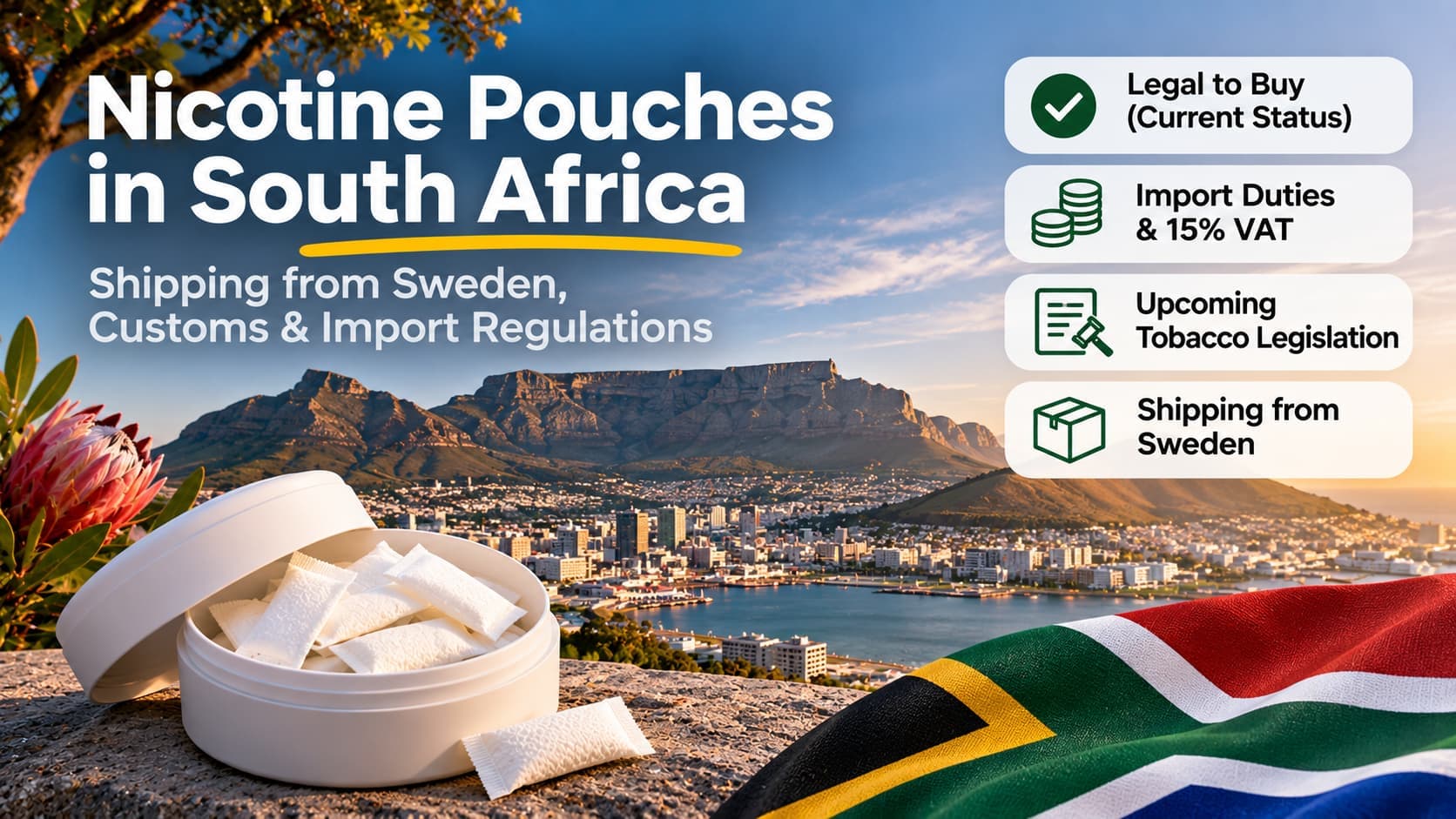
The nicotine pouch market in South Africa has attracted growing interest as tobacco-free nicotine products become more widely available internationally.
Sweden, one of the world's leading markets for nicotine pouches, has played an important role in the development of this product category. Swedish manufacturers and retailers offer products in a variety of flavors, nicotine strengths, and pouch formats.
For South African consumers exploring international online retailers such as Smokekicker, understanding how international shipping, customs duties, import taxes, and local regulations work is essential.
Unlike some countries that have introduced outright prohibitions on nicotine pouches, South Africa currently permits the sale of tobacco-free nicotine pouches under a regulatory framework that is still evolving.
However, purchasing nicotine pouches from overseas involves additional considerations, particularly regarding customs classification, import duties, and potential regulatory changes.
This guide explains what consumers in South Africa should know about nicotine pouches, shipping from Sweden, and the costs and requirements associated with international purchases.
The Nicotine Pouch Market in South Africa
Nicotine pouches are small oral products containing nicotine, plant-based fibers, flavorings, and other ingredients.
Unlike traditional Swedish snus, tobacco-free nicotine pouches do not contain tobacco leaf.
They are typically placed between the upper lip and gum, allowing nicotine to be absorbed through the oral lining without combustion or vapor.
Internationally, nicotine pouches have become an established product category in countries such as Sweden and the United States.
In South Africa, the category has developed within a regulatory environment that has historically focused primarily on conventional tobacco products.
As awareness of nicotine pouches increases, consumers may encounter products through domestic retailers and international online stores.
However, products sold in different countries can vary significantly in nicotine concentration, ingredients, labeling, and packaging.
Are Nicotine Pouches Legal in South Africa?
As of November 2026, tobacco-free nicotine pouches are generally considered legal in South Africa, although dedicated regulation remains limited.
The country's existing tobacco legislation is primarily based on the Tobacco Products Control Act 83 of 1993, as amended.
This legislation defines tobacco products by reference to their tobacco content and intended use.
Because modern tobacco-free nicotine pouches do not contain tobacco leaf, they are not automatically treated in the same way as conventional tobacco products under every provision of the existing legislation.
However, this does not mean that nicotine pouches are exempt from all South African laws or import requirements.
What About Online Sales?
South Africa's existing tobacco legislation prohibits the sale of covered tobacco products through postal services, the internet, or other electronic media.
The application of this restriction to tobacco-free nicotine pouches depends on their legal classification.
Consumers and international retailers should therefore distinguish between traditional tobacco-containing snus and tobacco-free nicotine pouches.
Before arranging an international order, it is important to confirm that the particular product and transaction comply with applicable South African requirements.
South Africa's Proposed Tobacco and Nicotine Regulations
South Africa is currently considering significant changes to its tobacco control legislation.
The proposed Tobacco Products and Electronic Delivery Systems Control Bill (B33-2022) aims to modernize the country's regulatory framework.
The bill addresses several areas, including:
-
Regulation of tobacco products and electronic nicotine delivery systems.
-
Restrictions on advertising and marketing.
-
Product packaging and labeling requirements.
-
Restrictions on sales to minors.
-
Controls on product displays and distribution.
-
Public health measures relating to tobacco and nicotine products.
In June 2026, Parliament's Portfolio Committee on Health approved a motion supporting further consideration of the bill.
In August 2026, the committee began detailed clause-by-clause deliberations.
During these discussions, lawmakers recognized the importance of distinguishing combustible tobacco products from non-combustible alternatives.
What Could This Mean for Nicotine Pouches?
Future legislation could introduce more specific rules covering tobacco-free nicotine pouches.
Potential areas of regulation include marketing restrictions, product labeling, age verification, and sales requirements.
However, proposed legislation should not be confused with regulations already in force.
As of November 2026, the bill remains under parliamentary consideration, and its final provisions may differ from earlier proposals.
Consumers and retailers should follow official parliamentary announcements for updates.
Shipping Nicotine Pouches from Sweden to South Africa
Sweden is an established international center for nicotine pouch manufacturing and distribution.
Swedish online retailers provide information about products available in the European market, where nicotine pouches are offered in a variety of formats and strengths.
For South African consumers researching international purchases, shipping is an important consideration.
International shipments from Sweden to destinations such as Johannesburg, Cape Town, Durban, and Pretoria generally involve export documentation, international transportation, customs clearance, and local delivery.
However, not all shipping providers accept nicotine products, and a carrier's ability to transport parcels to South Africa does not automatically confirm that nicotine pouches are eligible for shipment.
How Does International Shipping Work?
For products eligible for international delivery, the process generally involves several stages.
1. Order placement
The customer places an order with an international retailer. The retailer must verify product eligibility and available shipping arrangements.
2. Export documentation
The sender prepares the customs declaration, including product descriptions, quantities, declared values, and country of origin.
3. International transportation
The parcel is transferred to a postal operator or courier service for transportation to South Africa.
4. Customs processing
Upon arrival, the shipment is reviewed by the South African Revenue Service (SARS), which administers customs and excise requirements.
5. Payment of applicable duties and taxes
Depending on the product classification and shipping arrangement, customs duties, VAT, and other applicable charges may be assessed.
6. Final delivery
Once customs clearance has been completed and any regulatory requirements satisfied, the shipment can continue toward the recipient.
Delivery procedures may vary depending on whether the retailer uses a postal service or an international courier.
South African Customs Duties and Import Taxes
International purchases entering South Africa may be subject to customs duties, Value-Added Tax (VAT), and customs processing charges.
The South African Revenue Service is responsible for administering these requirements.
Unlike countries with a single general import duty rate, South Africa applies different customs tariffs depending on the classification of the imported goods.
Understanding Import Charges
|
Charge |
General treatment |
|---|---|
|
Customs duty |
Depends on product classification and applicable tariff |
|
VAT |
Standard rate of 15% |
|
Excise duty |
May apply depending on the product's tariff and excise classification |
|
Customs processing fees |
Depend on the carrier and clearance arrangements |
|
International shipping |
Depends on the retailer and delivery service |
The exact duty rate for a nicotine pouch shipment cannot be established solely from its retail price or country of origin.
South African customs authorities use tariff classifications to determine the applicable treatment.
How Is Import VAT Calculated?
South Africa applies a standard VAT rate of 15%.
For many imports originating outside the Southern African Customs Union, SARS calculates import VAT using the customs value, a 10% uplift, and applicable customs duties.
The general formula is:
Import VAT = 15% × (Customs Value + 10% of Customs Value + Applicable Customs Duties)
This means that the effective import VAT amount may be higher than simply calculating 15% of the product's purchase price.
For example, consider an imported product with a customs value of R1,000.
If no customs duty applies, the VAT calculation would generally be:
-
Customs value: R1,000
-
Additional 10% for VAT calculation: R100
-
VAT calculation base: R1,100
-
VAT at 15%: R165
The resulting import VAT would be R165.
This is a simplified illustration for ordinary imported goods and does not establish the actual customs or excise treatment of nicotine pouches.
Any applicable duties or other charges would affect the final amount.
Are Nicotine Pouches Subject to Excise Duty in South Africa?
South Africa imposes excise duties on several tobacco products and certain substitutes.
However, tobacco-free nicotine pouches are not necessarily classified in the same way as traditional cigarettes, cigars, or smoking tobacco.
The customs and excise treatment depends on the exact nature of the product and the relevant tariff classification.
International nicotine-containing products may fall within Chapter 24 of the customs tariff, including categories covering products intended for nicotine intake.
Importers should verify the applicable classification with SARS before calculating duties or accepting orders.
A product being tobacco-free does not automatically mean that it is exempt from all customs or excise charges.
Buying Nicotine Pouches Online in South Africa
For consumers researching online nicotine pouch purchases, there are several important differences between domestic shopping and international orders.
Domestic retailers operate within South Africa's local distribution environment.
International retailers must also consider export rules, shipping restrictions, customs procedures, and the legal requirements that apply when goods enter South Africa.
What Should Consumers Check Before Ordering?
Product eligibility
Confirm that the exact nicotine pouch product can legally be imported and that the proposed online transaction is permitted.
Shipping availability
Check whether the retailer and shipping provider accept nicotine pouches for transportation to South Africa.
Import duties and VAT
Determine whether the purchase price includes any import-related charges or whether those charges will be assessed separately.
Customs documentation
Accurate product descriptions, declared values, and classification information help facilitate customs processing.
Potential regulatory changes
South Africa's proposed tobacco legislation could introduce new requirements affecting nicotine pouch sales, distribution, and marketing.
Swedish Nicotine Pouches and International Online Retailers
Sweden has developed a substantial nicotine pouch industry, with manufacturers offering products in different sizes, moisture levels, flavors, and nicotine strengths.
Consumers researching the international market may notice several differences between Swedish and South African product selections.
For example, European nicotine pouch products may use different strength labeling systems.
Some manufacturers display nicotine content as milligrams per pouch, while others specify milligrams per gram.
These measurements are not interchangeable.
Consumers should therefore compare the actual nicotine content rather than relying solely on descriptions such as "strong" or "extra strong."
International retailers such as Smokekicker provide an opportunity to explore the wider European nicotine pouch market and learn about different product characteristics.
However, availability on an international website does not automatically establish that a product can legally be imported into South Africa.
Consumers should confirm the applicable requirements before arranging an order.
What Happens If a Shipment Is Held by South African Customs?
International parcels entering South Africa may be inspected by SARS.
Customs authorities may verify product descriptions, declared values, classifications, and supporting documentation.
If information is incomplete or a shipment requires additional authorization, customs clearance may be delayed.
Depending on the circumstances, authorities may request further documentation or refuse the release of goods that do not comply with import requirements.
SARS distinguishes between prohibited goods and restricted goods.
Prohibited goods cannot legally enter the country, while restricted goods may only be imported under specified conditions.
For nicotine pouch shipments, the relevant classification and any applicable restrictions should be established before transportation.
Incorrect customs declarations can also lead to additional charges, delays, or enforcement action.
Can You Import Nicotine Pouches for Personal Use?
South Africa distinguishes between commercial imports and goods imported for personal consumption.
However, personal use does not automatically exempt goods from customs duties, VAT, or applicable restrictions. Depending on the nature of the goods and the relevant import controls, personal shipments may still require documentation or authorization.
Consumers should not assume that ordering a small number of nicotine pouch cans eliminates import requirements. The South African Government provides guidance on importing controlled goods for personal use, while SARS publishes information about restricted and prohibited products.
Before ordering, consumers should verify whether the specific nicotine pouch products are eligible for personal importation.
The Future of Nicotine Pouches in South Africa
The South African nicotine pouch market may undergo further regulatory changes as Parliament considers the proposed Tobacco Products and Electronic Delivery Systems Control Bill.
The legislation represents an effort to modernize tobacco and nicotine regulation and address products that were less established when the existing laws were introduced.
Future requirements could affect product labeling, advertising, online sales, age verification, and market distribution.
For international retailers, changes to these rules may also affect cross-border e-commerce.
However, the final regulatory framework remains uncertain until legislation is formally adopted and implemented.
South African consumers and businesses should monitor announcements from Parliament, the Department of Health, and SARS.
Final Thoughts
South Africa represents an evolving market for tobacco-free nicotine pouches.
Unlike countries that impose broad prohibitions on the category, South Africa currently permits nicotine pouches, although dedicated regulatory requirements remain under development.
For consumers interested in the wider European market, Sweden remains an important source of information about nicotine pouch products and manufacturing.
International retailers such as Smokekicker provide insight into the variety of products available in Sweden and other European countries.
However, international purchases involve additional considerations, including shipping eligibility, customs declarations, VAT, import duties, and product classification.
With new legislation under parliamentary consideration, understanding both existing regulations and potential future changes is essential.
Consumers should verify applicable import rules and product eligibility before placing international orders.
Important information: Nicotine is addictive, and nicotine pouches are not risk-free. This article is intended for general informational purposes and does not constitute legal or tax advice. Product regulations, customs requirements, and shipping availability may change.
Last updated: November 2026.